

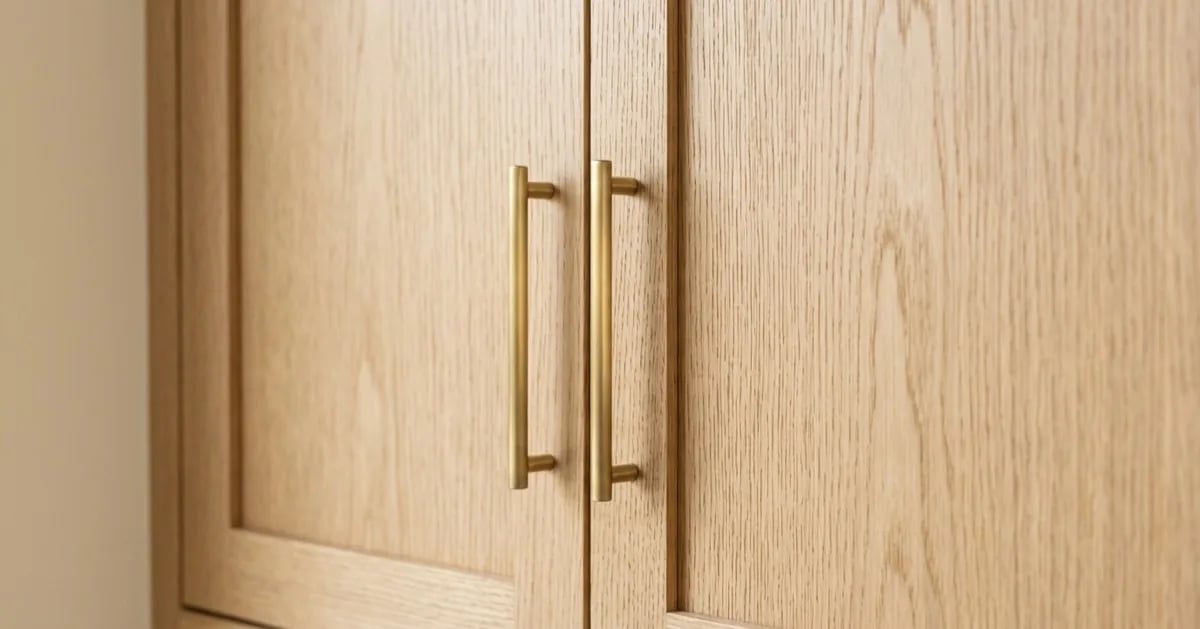
Cabinet hardware is the smallest decision in a kitchen and one of the most visible. You touch it dozens of times a day, and it quietly sets the tone of the room. The good news is that it is also one of the cheapest things to change later, which means you can afford to decide it last and decide it calmly.
Decide it after the big surfaces
Hardware should follow the cabinets, countertop and flooring, not lead them. Once those are chosen, hold sample handles against a cabinet door, ideally a real door or a sample panel rather than a picture, and see how they sit against the wood or paint.
Pick the metal first
Choose one main metal finish for the room and keep it consistent across handles, faucet and lighting. Warm finishes such as brass and bronze sit well with wood and cream or white cabinets. Cooler finishes such as chrome and nickel suit lighter, more minimal rooms. Black is bold and shows up strongly against light cabinets.
You can mix metals deliberately, but it works best when one finish clearly dominates and the second appears only in small amounts.
Handles or knobs, and what size
A few practical rules of thumb:
- Drawers and large doors suit a long pull, which is easier to grip with wet hands or while carrying something.
- Small cabinets can take knobs, which feel lighter and more traditional.
- Size matters more than people expect. Hardware that is too small looks lost on a large door. A common guideline is to scale the handle length to the size of the drawer front, rather than choosing everything the same.
Check the hole spacing on your cabinets before you buy. Replacing existing hardware is simplest when the new pieces match the existing hole spacing, and drilling new holes in finished cabinets is a step best avoided.
Test the feel, not just the look
If you can, handle the real thing in a store. Check the weight, the edges and how your hand fits around it. A handle that looks great in a photograph can feel sharp or awkward when you use it, and you will use it every day.
Buy one first
Before ordering forty pulls, order one. Fit it on a door, live with it for a few days, and check it in the morning light and in the evening. A single sample costs very little compared with returning a full order.
Let the household weigh in
Hardware is a very personal decision that affects everyone who uses the kitchen. Put your two or three finalists where everyone can see them, ask each person to rate them, and notice where opinions agree. If two options tie, pick the one that is easier to clean, since that tends to decide it in the end.
Where RenoVote fits
Save each handle as a real product with its link and price in RenoVote, and let the people in your household vote on them. When one wins, it becomes a task with a price, so your budget and your shopping list update together. Start free whenever you are ready.
The short version
- Choose hardware last, after the big surfaces.
- Pick one dominant metal.
- Match the size to the drawer or door.
- Check hole spacing before buying.
- Test the feel, and order a single sample first.
- Let everyone vote on the finalists.
The photos and illustrations on this page were created with AI.