

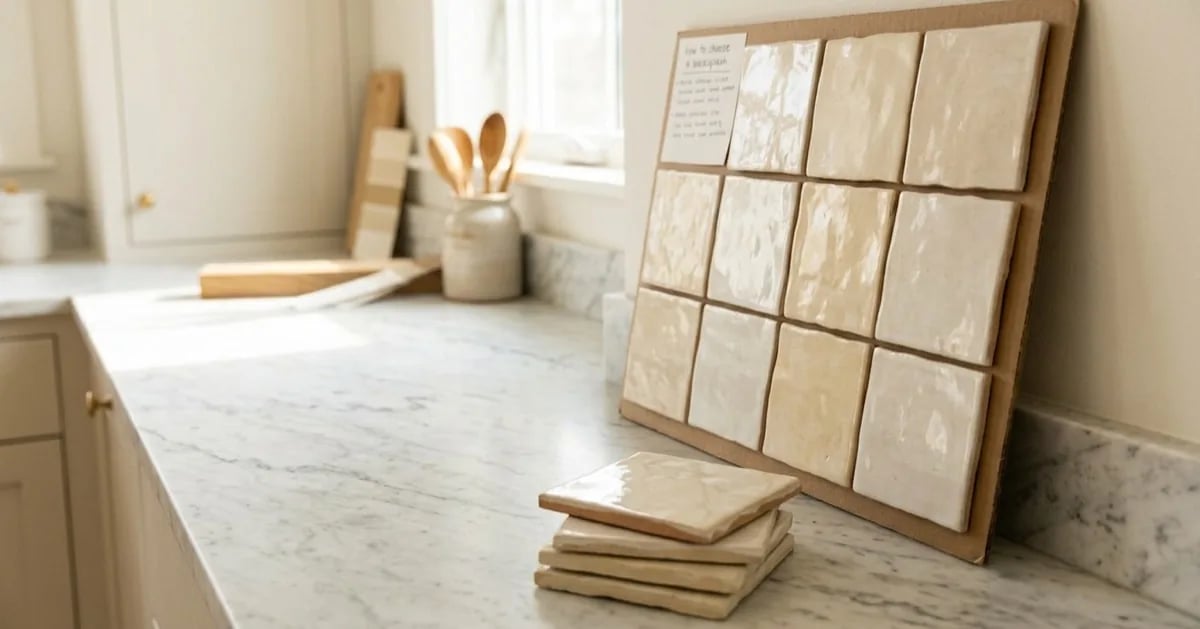
The backsplash is one of the few places in a kitchen where you can add real character without a large budget. It is also the place people most often regret, because it is a visible, permanent surface chosen from a small sample under showroom lighting.
Here is how to make the choice with fewer surprises.
Start from what is already fixed
A backsplash sits between two surfaces: the countertop and the cabinets. Choose it last of the three, or at least with both in front of you. Bring a piece of the countertop and a cabinet door or paint sample, and hold the tile samples against them.
If the countertop has strong veining or pattern, a calmer tile usually looks better. If the countertop is plain, the tile can carry more texture and variation.
Look at the finish, not just the color
Two tiles in the same color can behave very differently on a wall.
- Glossy tiles reflect light and make a small kitchen feel brighter. They also show every smear and every flaw in the wall behind them.
- Matte or honed tiles feel softer and hide fingerprints, but can hold onto grease and take more cleaning near the stove.
- Handmade or irregular tiles, with slight variation from one piece to the next, give a wall depth and movement. Expect that variation, because it is part of what you are paying for.
Think about size and grout
Smaller tiles mean more grout lines, which adds visual texture and also more to clean. Larger tiles mean fewer lines and a calmer wall.
Grout color changes the look more than most people expect. A grout close to the tile color makes the wall read as one soft surface. A contrasting grout draws a grid. Ask to see your tile with the actual grout color, not just the tile alone.
Check it in your own light
Take the samples home. Put them on the wall, or tape them up, and look at them in the morning, at midday and with the evening lights on. Natural light, warm bulbs and cool bulbs all change how a tile reads. This single step avoids more regret than anything else on this list.
The two photos below show two different boards of similar cream tiles, one by a window in daylight and one by a lamp in the evening. They are not the same samples, but they make the point: a pale glazed tile can look quite different depending on the light it sits in, so judge yours in the room where it will live.
Consider how you cook
Be honest about how much you cook. A wall behind a gas range gets splashed more than one behind a rarely used cooktop. Choose something you will be willing to wipe down, and ask the supplier whether the tile needs sealing and how often.
Order extra
Tile comes in batches, and color can vary slightly between them. Order enough for the whole job plus a margin for cuts and breakage, and ideally keep a few spares for future repairs, since the exact tile may be discontinued by then.
Compare with other people, not just your own eye
A tile you love alone at the showroom may split opinion at home. Save the final two or three options with their real links, put them somewhere everyone can see, and let each person rate them before you talk. You will often find that one option is acceptable to everyone, which is usually the right one.
Where RenoVote fits
In RenoVote you can save each tile as a real product with its link and price, put the finalists up for a vote with the people you live with, and turn the winner into a task with its estimate. The sample you loved stays attached to the decision instead of getting lost in a camera roll. Start a free workspace to try it.
The short version
- Choose with the countertop and cabinets in front of you.
- Decide the finish before the color.
- Look at size and grout together.
- Check samples in your own light, at different times of day.
- Order extra from the same batch.
- Let everyone rate the finalists before you decide.
The photos and illustrations on this page were created with AI.