

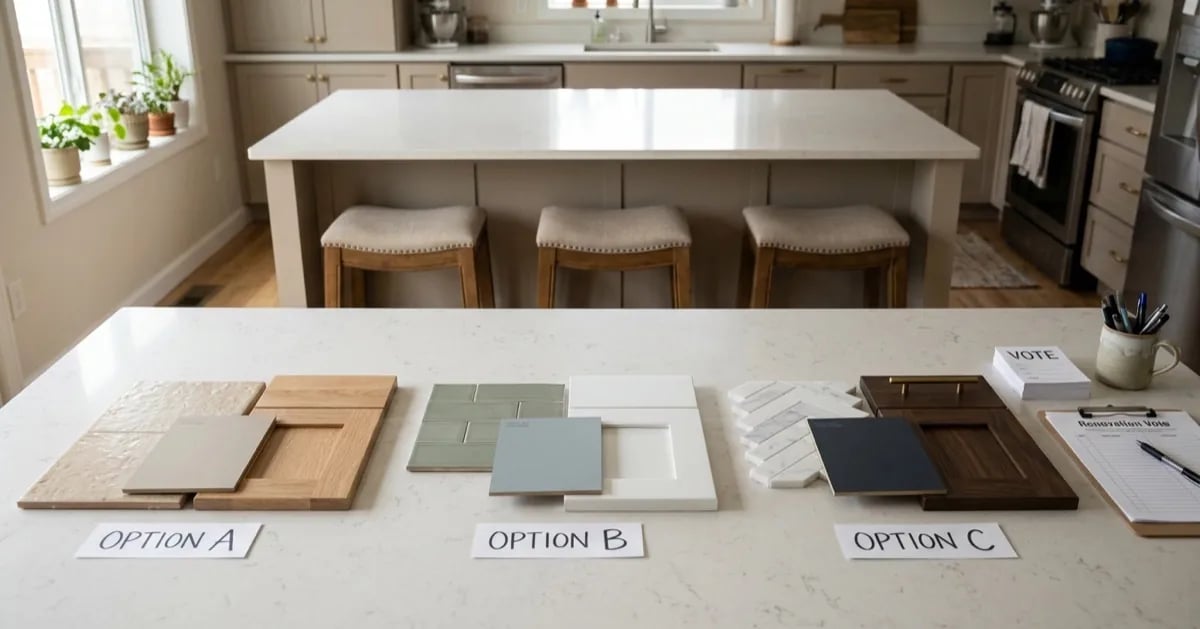
When two or more people share a home, a renovation decision belongs to all of them. The problem is that most households decide by whoever has the strongest opinion, or whoever cares the least about being right. Neither is fair, and both tend to leave resentment behind.
A simple vote, run properly, fixes most of this. Here is how.
Decide who gets a say
Be explicit about who votes. In most households it is every adult who will live with the result. Sometimes older children get a say on their own rooms. A parent living with you, a roommate or a long-term guest might be included or not, depending on how much the room matters to them.
Agreeing this before the first vote prevents the argument about whether the vote counts.
Limit the options
Choose three or four options before anyone votes. Too many options splits the vote and leaves nobody satisfied. Too few can feel like a foregone conclusion.
Make sure every option is acceptable to everyone who is voting. If someone would truly refuse one of them, remove it first. A vote should choose between things people can live with, not force a loss on someone.
Use real, comparable options
Compare like with like. If you are voting on a sofa, each option should show the same information: a photo, the price, the size, the material and a link. A vote between a photograph and a vague idea is not a fair comparison, because the more concrete option always wins.
Vote privately first
Ask each person to give their view before anyone discusses. If one person speaks first, others tend to follow, especially if the first speaker is persuasive or senior. A private vote reveals what people actually think.
You can use a simple scale, such as asking each person to rate every option from one to five, rather than choosing a single winner. Ratings show how strongly people feel, and they often reveal that an option nobody loved but everybody accepted is the best compromise.
Look at the result together
Once everyone has voted, share the results. Look for three patterns:
- Clear winner: one option is ahead for everyone. Decide and move on.
- Close tie: two options are level. Discuss what matters most to each person.
- Split: two people strongly prefer different options and rate the other poorly. This is the interesting case, and it deserves a conversation, not a majority.
Handle a real split
When the vote shows a genuine disagreement, ask each person two questions: what do you most like about your choice, and what bothers you most about the other? The answers often reveal that the disagreement is about one specific thing, such as maintenance or price, and a third option can address it.
If you cannot resolve it, use a rule you agreed in advance. A common one is a small number of vetoes per person across the whole project, spent on whatever they care about most.
Record the outcome
Write down what was chosen and when. Decisions that are not recorded get reopened, usually at the worst moment. A decision that is attached to the product, its link and its price is much harder to relitigate.
Accept the result
The vote only works if everyone accepts it. Agree beforehand that the result stands unless new information, such as a price change or an unavailable product, makes it unworkable. Reopening a settled decision because you did not like the outcome undermines every vote that follows.
Where RenoVote fits
RenoVote lets you put ideas and real products up for a vote with the people around you, so differing views show up early and get talked through, instead of being discovered halfway through the work. You can start with a free workspace and invite everyone who has a stake.
The short version
- Decide who votes before the first vote.
- Limit the options and make them comparable.
- Vote privately before discussing.
- Look at the result together and talk about real splits.
- Record the outcome and stick to it.
The photos and illustrations on this page were created with AI.