Most people begin a renovation by collecting pictures. A hundred saved photos later, they know they like "a warm, bright kitchen" and have no idea what to buy. A mood board only helps if it narrows your choices, and most never do.
Here is how to build one that does.
Collect widely, then look for the pattern
Start by saving everything you are drawn to, without filtering. Rooms, materials, colors, a single light fitting from a magazine, a photo of a friend's hallway. Do this for a week or two.
Then step back and look for repetition. Which materials appear again and again? Which colors? Is it wood, or stone, or a particular metal? The things you keep saving, not the things you say you like, are your actual taste.
Write down the pattern in a few words. "Warm wood, brass, soft white, plenty of natural light" is far more useful than a hundred images, because you can check any new idea against it.
Move from images to products
The step that turns a mood board into a plan is replacing pictures with specific things. A photo of a kitchen is inspiration. The exact pendant light in that kitchen, with a link and a price, is a decision you can make.
For each element you care about, find the real product, or the closest real alternative, and save it with:
- The link to the product page
- The price
- The dimensions
- The finish or color name
- Any lead time
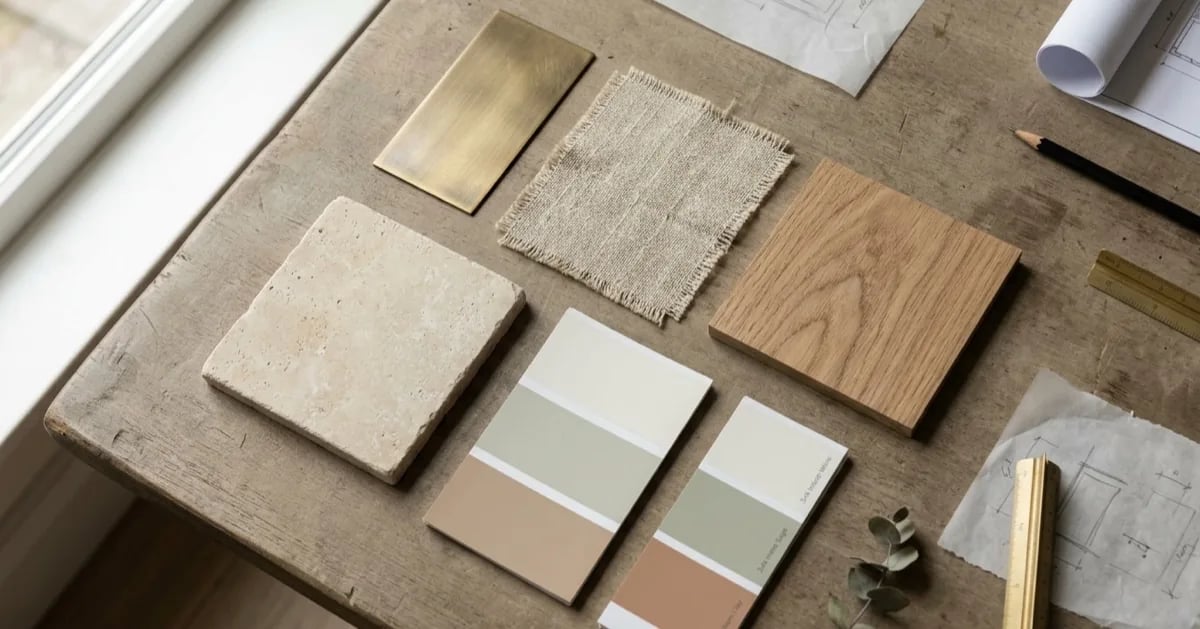
Physical samples belong on the board too. A brass swatch beside a fabric swatch tells you more about how they will sit together than any photograph.
Group by room and by decision
Organize what you have saved by decision rather than by style: all the pendant lights together, all the tiles together, all the handles together. This lets you compare like with like, which is what you need when you choose.
Within each group, narrow to three or four. More than that, and the comparison turns into browsing.
Keep samples physical when you can
Screens lie about color and texture. Order samples of tile, fabric, paint and metal finishes, and keep them together on a tray or desk. Compare them in daylight and under your evening lights. Nothing replaces holding two materials next to each other.
Share it before you fall in love
The mistake that causes the most arguments is falling in love with a choice before showing it to the people who share the space. Put your shortlist where everyone can see it, and let each person respond before the decision is made.
Ask each person to react to the whole set, not only their own contributions. Often you will find an unexpected consensus on something nobody thought was a favorite.
Know when to stop
A mood board is finished when each decision has one clear winner, not when you have seen everything. The point is to stop collecting and start deciding. If you are still adding images and have not made a choice, you are researching, not planning.
Where RenoVote fits
RenoVote is designed for this: collect ideas and real products with real links, vote on them with the people around you, and turn the favorites into tasks. The board becomes a plan, with each choice linked to the real product and its price. Start free to build your first one.
The short version
- Collect widely, then find the pattern.
- Replace pictures with specific, linked products.
- Group by decision and keep three or four options in each.
- Use physical samples.
- Share the shortlist before anyone is attached.
- Stop collecting once each decision has a winner.
The photos and illustrations on this page were created with AI.